Under the auspices of North Macedonia’s Presidency of the European Union Strategy for the Adriatic and Ionian Region (EUSAIR), a regular meeting of the Pillar 4 Thematic Steering Group on Sustainable Tourism took place in Skopje on 16–17 April 2026. This thematic pillar is jointly coordinated by Albania and Croatia.
The session was opened by Pillar Coordinator Iva Čaleta Pleša from Croatia’s Ministry of Tourism and Sport, who also introduced Elkana Himci as the new coordinator representing Albania’s Ministry of Tourism, Culture and Sports. The coordination team further included Albania’s deputy coordinator Matina Hyka and Lorena Borovnjak from the Croatian Ministry’s EUSAIR Facility Point project team.
Held in a hybrid format, the meeting gathered representatives from all ten participating countries. Discussions continued on strategic projects, while participants were introduced to initiatives led by the Youth Council, key conclusions from the EUSAIR Governing Board meeting in Ohrid in March 2026, and updates regarding the European Commission’s upcoming multiannual financial framework.
Implementation of the EUSAIR relies on three governance projects, each of which outlined its main activities. The EUSAIR Facility Point provides administrative and operational support, particularly for horizontal actions. The SP4EUSAIR project presented its approach to developing strategic projects, while the STeP project introduced a new platform aimed at enhancing cooperation and networking.
An interactive segment focused on the horizontal theme of EU enlargement. The Strategy includes ten countries: four EU Member States (Croatia, Greece, Italy, and Slovenia), five candidate countries (Albania, Bosnia and Herzegovina, Montenegro, North Macedonia, and Serbia), and one third country, San Marino. This diverse composition offers strong opportunities for collaboration and mutual learning. External experts engaged by the Strategy examined ways to strengthen cooperation between Member States and candidate countries. Through a “world café” format, participants worked in groups to discuss balanced tourism and intangible cultural heritage, aiming to identify ways to share knowledge and best practices. Both topics were selected based on their relevance to community well-being, in line with the Action Plan and current tourism trends.
A presentation on tourism trends served as a starting point for discussions on future strategic projects and publications. Participants were informed about a proposed collaboration with the SMART ERA project, which aims to develop a strategic initiative focused on rural tourism. Rural development was highlighted as a promising area for a cross-cutting strategic project involving multiple thematic pillars. Following the existing project on the Mediterranean diet and sustainable tourism—bringing together Pillars 1 (Blue Economy), 4 (Sustainable Tourism), and 5 (Social Cohesion)—the proposed “Smart Rural Development” project would also involve Pillars 2 (Energy and Transport) and 3 (Environmental Quality). Members expressed strong interest in continuing cooperation in this area.
The central event of North Macedonia’s EUSAIR Presidency will be the Forum, scheduled for 18–21 May 2026 in Skopje. During the Forum, Pillar 4 will present progress in implementing the Action Plan since its adoption in May 2025, incorporating perspectives from coordinators, members, the Youth Council, and tourism stakeholders. Participants are encouraged to take part actively, as the program will include workshops and discussions addressing sustainable tourism.
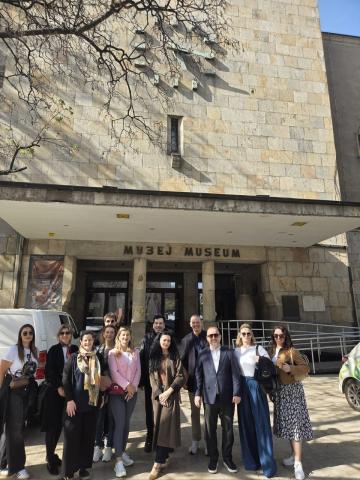
On the following day, attendees visited the Skopje City Museum and the Memorial House of Mother Teresa as part of an organized tour, gaining insight into the city’s rich history and contemporary life, while reflecting on a shared European future.