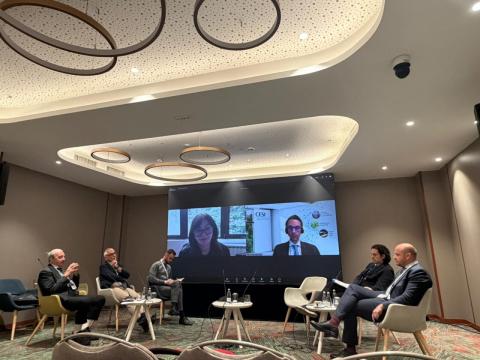
Energy security and the transition towards more sustainable and resilient energy systems were at the heart of the Energy Thematic Session held during the 11th EUSAIR Annual Forum in Skopje, North Macedonia, from 18 to 20 May 2026. Chaired by Prof. Sergio Garribba, Pillar 2 Energy Coordinator, the session provided an opportunity to examine how the Adriatic-Ionian region can enhance its preparedness and capacity to address both present energy concerns and future risks.
The discussion began with an overview of the current energy situation across the region. Mr. Davide Tabarelli, President of Nomisma Energia, outlined how recent global developments, notably the gas crisis of 2022 and continuing geopolitical instability, have highlighted the region’s exposure to external disruptions. These developments have reinforced the need to reduce energy dependence, diversify supply sources, and modernise existing energy infrastructures. While countries across the Adriatic-Ionian area face different national circumstances, many of the challenges are shared. At the same time, considerable opportunities exist, particularly in expanding renewable energy production and strengthening regional collaboration. Participants stressed that the energy transition should not be viewed solely as a compliance requirement but rather as an opportunity to stimulate innovation, attract investment, and support sustainable long-term growth.
The importance of infrastructure development emerged as a key topic throughout the session. Mr. Alessio Cipullo, Head of Italy and EU Public Affairs at CESI SpA, emphasised the crucial role of electricity grids in supporting the transformation of the energy sector. Modern and interconnected grids are increasingly necessary to accommodate higher levels of electrification, facilitate the integration of renewable energy sources, and maintain security and reliability of supply across national borders. The Adriatic-Ionian region was recognised as having significant potential to serve as a strategic energy corridor linking European Union Member States with neighbouring countries. Realising this potential, however, will require continued investment in interconnected and future-oriented energy networks capable of meeting evolving demand patterns.
The benefits of macro-regional cooperation represented a recurring theme throughout the debate. Mr. Alberto Biancardi highlighted the contribution of Twinning projects as valuable mechanisms for strengthening institutional capacities, facilitating the exchange of expertise, and promoting greater alignment of practices among participating countries. Such instruments were identified as particularly useful for supporting convergence and cooperation across the region. Complementing this perspective, Mr. Peter Hlusek, Gas Market Expert at the Energy Community Secretariat, underscored the importance of coordinated action at the European level in responding to energy crises. He noted that collective approaches can play a significant role in safeguarding energy supplies and reducing the economic and social impacts associated with high energy prices on both households and national economies.
The session concluded with a shared recognition that strengthening energy security in the Adriatic-Ionian region requires a comprehensive and forward-looking strategy. Such an approach must combine infrastructure investments, deeper market integration, and coordinated financial commitments with continuous knowledge sharing and cooperation among regional partners. Participants acknowledged that the EUSAIR framework provides a unique platform for facilitating this exchange of experience and fostering joint initiatives. By building on existing cooperation mechanisms and further developing collaborative actions, the macro-region can move towards energy systems that are more secure, better interconnected, and more resilient, while simultaneously advancing the objectives of the clean energy transition and addressing future energy challenges.