The opening day of the 11th Annual EUSAIR Forum featured a series of well-executed panels covering a broad range of key issues relevant to the EUSAIR region.
Mr. Bekim Sali, Minister of European Affairs and host of the 11th EUSAIR Forum from North Macedonia, stated that the Forum reaffirms regional cooperation as a strategic instrument for strengthening stability, connectivity, resilience, and the European integration process of the Western Balkans.
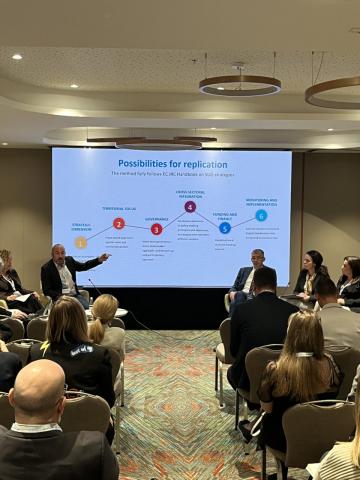
The Forum officially began with a panel on Tools for EUSAIR Integration, organised by the UN Office for Project Services and DG REGIO. The session examined how territorial development tools and place-based approaches can reinforce EUSAIR governance and contribute to more coherent cross-border cooperation through concrete practices and flagship initiatives. Ms. Radica Koceva stressed that “territorial strategies are based on partnership, principles and inclusiveness, meaning that all stakeholders at local levels have been included in the definition of the priorities.”
The EUSAIR Youth Council Meeting of Members represented another important gathering, during which council members reviewed current plans, reflected on past achievements, and shared feedback on ongoing developments in order to maintain their proactive and dynamic progress. Mr. Bojan Kordalov later emphasized this point by stating that “Young people are the future AND the present.”
The final morning panel, focusing on AI as a tool in citizen-centred public services, explored how artificial intelligence presents a dual opportunity for the EUSAIR region. On one side, AI can accelerate institutional modernisation and macroregional convergence, while on the other, it may deepen existing inequalities and affect public trust. Ms. Erika Piirmets highlighted the importance of a mindful approach to AI adoption, emphasizing the direct connection between input and output: “Trash in, trash out. What are you doing with AI? Why are you adopting this? What are you trying to achieve with this?” The discussion examined AI’s transformative potential across all five EUSAIR Pillars, while stressing that citizen satisfaction and institutional accountability must remain at the centre of its implementation.
Another panel, dedicated to smart tools for biodiversity and sustainable land use and organised by the EUSAIR Presidency of North Macedonia together with the EUSAIR Youth Council, focused on AI’s potential to improve environmental quality and protect terrestrial ecosystems within the Adriatic-Ionian region. AI was presented as an opportunity for data-driven monitoring and smarter land management, with solutions that could support biodiversity protection, climate resilience, and sustainable regional development, while also acknowledging the hidden environmental costs associated with these technologies. Ms. Lejla Hadžijusufović from the EUSAIR Youth Council summarized this perspective by stating that “using AI shortens our time but it also shortens our planet’s time.”
The opening day concluded with a session highlighting the macroregional importance of investing in youth. Discussions focused on the significant challenge posed by the outflow of young people, which weakens economic recovery, social cohesion, and national labour markets. The session also examined the mismatch between existing educational, vocational, and skills-development programmes and the realities and expectations facing younger generations entering the labour market.
Throughout the discussions, panellists emphasized the importance of inclusivity, sustainability, and investment in future generations, while maintaining a strong focus on responsibility toward local communities and the planet.