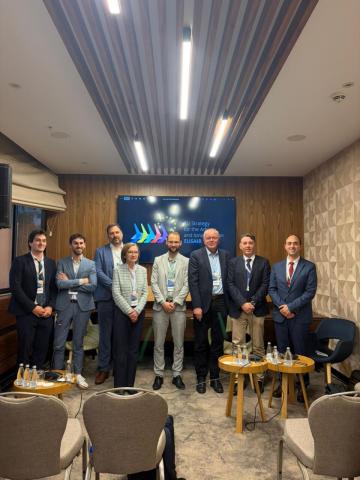
The Transport Thematic Session, organised within the framework of the 11th EUSAIR Annual Forum held in Skopje, North Macedonia, from 18 to 20 May 2026, brought together representatives of national and local governments, academic institutions, and the EUSAIR Youth Council. The session provided a platform for participants to share experiences and present practical examples of sustainable urban mobility initiatives being implemented throughout the Adriatic-Ionian region. Entitled “Boosting the uptake of Sustainable Urban Mobility Policies: best practices and ongoing initiatives in the Adriatic-Ionian Cities”, the session was moderated by Ms. Jasminka Kirkova, Pillar 2 Coordinator from the Ministry of Transport and Communications of North Macedonia, and Mr. Jovica Rakic, Pillar 2 Coordinator from Serbia’s Ministry of Construction, Transport and Infrastructure.
Throughout the discussion, participants presented a number of successful experiences from cities across the Western Balkans, demonstrating the region’s increasing efforts to develop urban transport systems that are modern, sustainable, and well-integrated. Drawing on concrete examples from local contexts, Mr. Lovren Markic from the City of Skopje and Mr. Ajdin Džananović from the University of Sarajevo showcased ongoing initiatives aimed at promoting innovative mobility solutions with lower environmental impacts. Particular attention was given to Sustainable Urban Mobility Plans (SUMPs), which were recognised as essential policy instruments for translating European Union objectives into practical actions at the local level, while helping municipalities better coordinate mobility strategies and investment priorities.
A recurring message during the session was the importance of strengthening public transport systems. Investments in high-capacity transport infrastructure, including tramway and metro networks, were identified as fundamental components of a sustainable urban mobility framework.
Mr. Franc Zepic from Slovenia’s Ministry of Infrastructure shared insights into Slovenia’s experience in implementing sustainable mobility policies, illustrating how strategic objectives can be successfully converted into concrete measures. The discussion also highlighted the importance of expanding cycling infrastructure, both as a means of supporting decarbonisation efforts and of improving the overall quality of life in urban areas. In addition, speakers stressed the value of intermodal transport solutions that facilitate efficient and seamless transfers between different transport modes.
Innovation and digital technologies were recognised as critical factors in advancing sustainable mobility. In particular, Mobility as a Service (MaaS) solutions were highlighted as important tools for improving the user experience and increasing the efficiency of transport systems. Examples discussed included integrated ticketing platforms, unified fare structures, and real-time travel information services, all of which contribute to making mobility services more accessible, convenient, and user-oriented.
The session also reaffirmed the importance of macro-regional cooperation within the EUSAIR framework as a mechanism for promoting the exchange of expertise and facilitating the transfer of successful approaches among participating countries and cities. The involvement of Mr. Francesco Moroni and Mr. Klajdi Kaziu from the EUSAIR Youth Council, representing San Marino and Albania respectively, further emphasised the value of ensuring that younger generations play an active role in shaping the future direction of sustainable mobility policies across the region.
Participants additionally underlined the significance of cross-border collaboration and the effective use of results generated through existing projects, including those funded under Interreg programmes. Such initiatives were recognised as valuable instruments for supporting the development of urban nodes within the TEN-T network and for accelerating the adoption of European Union standards, particularly in countries currently engaged in the EU enlargement process.