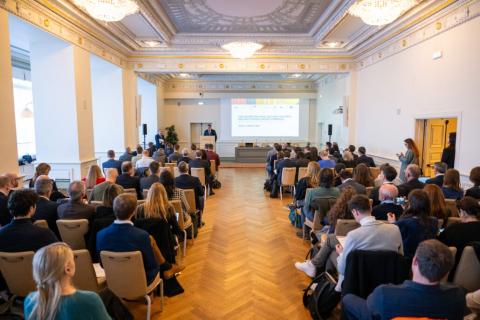
On 25 March 2026, the city of Trieste hosted the event titled “Digitalising the Road Last Mile for Ports and Multimodal Freight Terminals: Data Sharing and Interoperability for Efficient Freight Flows.” The initiative was organised by the Port Network Authority of the Eastern Adriatic Sea in collaboration with the Autonomous Region of Friuli Venezia Giulia and Interporto di Trieste, under the framework of the EU Strategy for the Adriatic and Ionian Region (EUSAIR).
The event provided a valuable platform to strengthen collaboration across the Adriatic-Ionian macro-region around a common strategic priority: enhancing the performance, sustainability, and integration of freight transport systems through digital tools and improved data interoperability.
Consistent with the goals of EUSAIR Pillar 2 – Connecting the Region – and its flagship initiative Green and Smart Port Hubs, discussions underscored the central role of ports and multimodal hubs in enabling more efficient and environmentally sustainable logistics chains. Particular attention was given to the digitalisation of the road “last mile,” identified as a critical area where coordinated macro-regional efforts can deliver concrete results, such as reduced traffic congestion, lower emissions, and more reliable freight movements.
In his opening address, Prof. Pierluigi Coppola, Transport Coordinator for EUSAIR Pillar 2, emphasised the importance of expanding successful practices developed in Northern Adriatic ports to the broader macro-regional level. He highlighted how cooperation projects support alignment among stakeholders and facilitate the transfer of effective solutions across different regions.
The event gathered a broad spectrum of participants, including representatives from European institutions, national and regional authorities, port administrations, intermodal terminals, and logistics operators. This diversity of actors reinforced the importance of adopting integrated approaches and developing shared solutions across various governance levels and geographic areas.
A key point of discussion was the need to better coordinate European and national funding mechanisms to support both innovation and implementation. Insights from projects such as ACCESSMILE, MILEPORT, PRESPORT, MERIDIAN, and ELODIE illustrated how cross-programme cooperation can amplify results, enabling the transition from pilot initiatives to tangible operational improvements.
Participants also highlighted the growing importance of advanced digital technologies—such as real-time traffic management systems, interoperable data platforms, and automated gate solutions—in improving port accessibility and logistics efficiency. At the same time, it was stressed that digital transformation must be aligned with broader sustainability goals, contributing to the twin transition of the transport sector.
Overall, the event reaffirmed the value of the EUSAIR framework in promoting dialogue, knowledge exchange, and coordination among stakeholders. By fostering synergies between projects, policies, and funding instruments, the macro-regional approach can play a key role in accelerating the shift towards greener, smarter, and more interconnected port systems across the Adriatic-Ionian region.