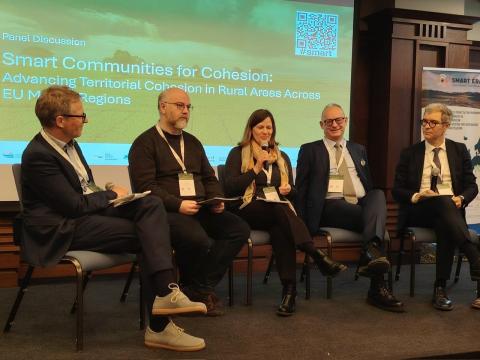
Under the auspices of the Bulgarian Presidency of the EU Strategy for the Danube Region, and in collaboration with the SMART ERA project, an engaging event titled “Bridging Vision and Action: Smart Rural Development That Leaves No Region Behind” took place in Sofia, Bulgaria, on 24 March 2026.
The opening session established the overall direction of the event, introducing key questions that guided subsequent discussions. These were explored through a variety of formats, including presentations, panel discussions, and interactive workshops.
The panel gathered representatives from all four EU macro-regional strategies—Danube, Alpine, Baltic, and Adriatic-Ionian—alongside representatives of the European Commission. Participants highlighted that cooperation and mutual trust are essential drivers of development and play a crucial role in improving the quality of life across regions.
The Ministry of Tourism and Sport of the Republic of Croatia, together with the Ministry of Tourism, Culture and Sports of the Republic of Albania, coordinates the fourth thematic pillar—Sustainable Tourism—within the EU Strategy for the Adriatic-Ionian Region. During the panel, they presented the opportunities for developing smart rural tourism within the framework of the Strategy, taking into account the updated Action Plan.
Rural development has been an integral part of EUSAIR since its establishment. However, the revised Action Plan adopted in May 2025 places stronger emphasis on cross-pillar cooperation in this area, defining it as a horizontal priority. This approach opens new possibilities for collaboration among thematic pillars and fosters closer links with other macro-regional strategies.
Funded by the Horizon Europe programme, the SMART ERA project seeks to strengthen rural areas through a methodology centered on community involvement and collaborative problem-solving. Its Smart Innovation Packages are currently being implemented in several pilot regions, which were showcased during the Sofia event.
In addition, the SMART ERA project promotes cooperation among all four macro-regional strategies, recognizing both the importance of rural areas in Europe and the shared challenges they face. These include depopulation, climate change, limited physical and digital connectivity, and a lack of economic opportunities. By applying this methodology, project partners aim to deliver practical results and insights that can be replicated in other regions, enhance rural living conditions, and improve governance policies for local communities—ultimately helping to attract new residents and opportunities.
The joint event of the four macro-regional strategies led to several important conclusions that call for continued efforts: cooperation is vital for the prosperity of regions and their populations; strategies that actively involve communities and rely on ongoing collaboration and communication are demanding but essential; and the experience gained through macro-regional cooperation should be further utilized and strengthened. Altogether, these efforts contribute to reinforcing EU cohesion policy as well as enlargement policy. Ultimately, progress in Europe depends on working together.